Wednesday, October 31, 2012

Hotline Miami Review - Trip On This


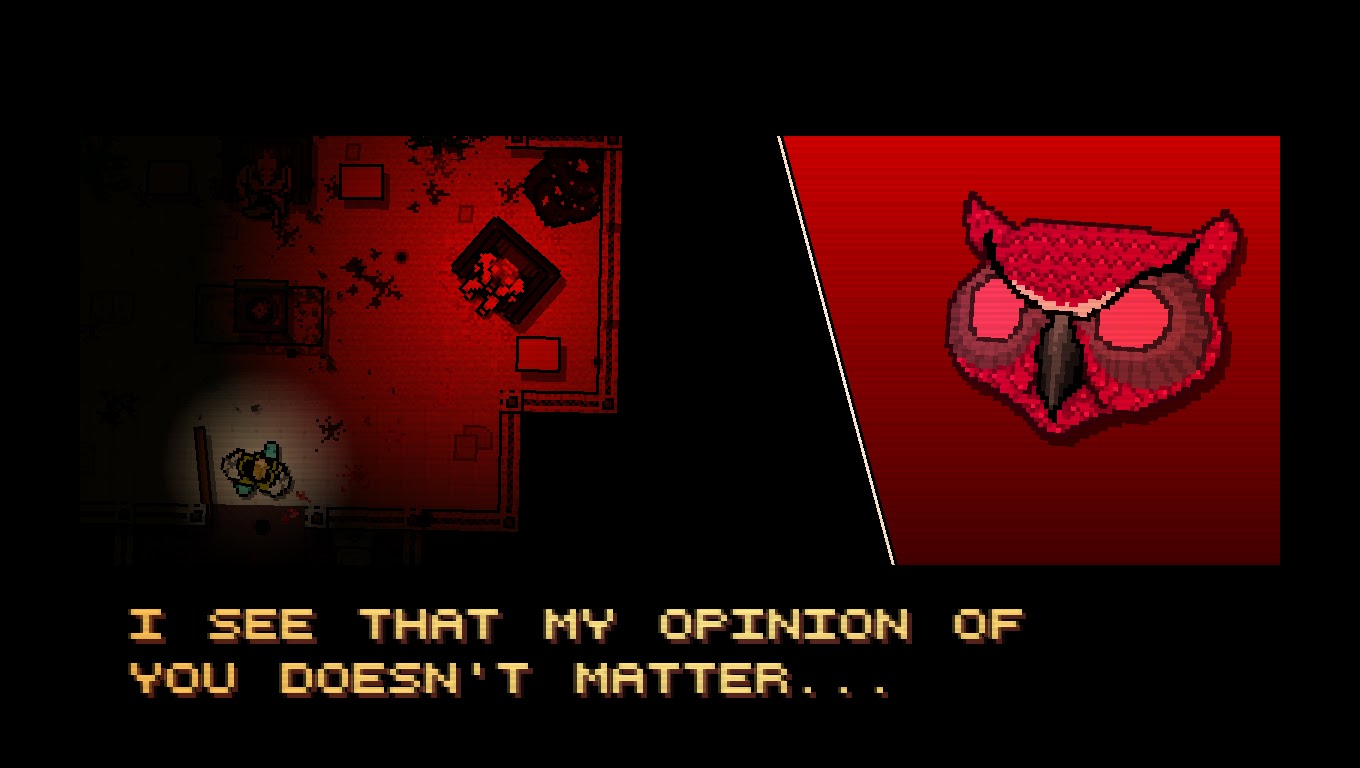
I'm not going to pretend that I can sum up what Hotline Miami is better than the game's publisher Devolver Digital, so here it is straight from the horse's mouth:

Gamers will step into the neon-soaked underground of 1980s Miami as bizarre messages on your answering machine seem to be urging you to commit terrible acts of violence against a nameless group of armed thugs. Overflowing with raw brutality and skull crushing close combat, Hotline Miami demands sharp reactions and a creative approach to navigate a gauntlet of 20 multiscreen missions. Wield 35 different weapons, collect 25 game-altering masks, and unveil a dark, surreal storyline that will force you to question your role in this murderous spree.

So there you have it: a nice basic summary of what this game is all about.  Hotline Miami that takes a very barebones story and wraps it around a few simple gameplay mechanics that have some depth in execution, and then presents them all with a perfectly tuned aesthetic that marries each element together into a cohesive package.  Three basic ingredients: Story, game, and presentation combined to make one game that is greater than each of those parts.

The Story in Hotline Miami takes place over the course of spring and summer of 1989.  The majority of it follows the same pattern: phone message, killing spree, brief encounter with a "friend" at the video rental or pizza parlor.  Most every day is like this.  Occasionally your character will meet in a darkened room with three other masked individuals who'll menacingly question him about what he's doing.  Somewhere around the midpoint of the game, it starts to get more and more clear that your character is becoming mentally unhinged or maybe has been all along.  How much of the story is really happening is unclear after playing through it once, and towards the end you'll wind up seeing some things that seem to directly contradict portions of the game you'd previously played through.  When it's done you'll probably have more questions than answers which really works in service of the story.  I'm not sure if there's any real depth to the story, or if it is merely the illusion of depth, but they've managed to make it so that one is just as good as the other.

The game plays mostly as a tactical twin-stick shooter.  Make no mistake though, charging in blindly guns a' blazing will just get you killed most of the time.  You'll need to sneak around and dispatch enemies quietly with melee attacks for as much of each level as possible, since melee kills won't draw attention like guns do.  Unless you're actively holding shift down and moving the cursor towards the edges of the screen, your field of view will be pretty limited. This gives the action kind of an up-close immediacy, forcing you to focus on one room at a time.  Punches, opened doors, and thrown weapons can knock enemies down, taking them out of the action briefly and also making them vulnerable to gruesome execution attacks.  Melee weapons are mostly one hit kills, and guns usually kill in one or two hits as well.  You're as vulnerable as the enemy is, so you'll die a lot, but respawns are instant, allowing you to jump back in the action quickly.

For the most part, the game plays really great. It gives you a limited toolset and then allows you to use it in an almost sand-box fashion to plan your rampage across each level.  It's very tactical and precise, but still occasionally devolves into a furious firefight or all out melee that'll have you improvising like mad in order to survive. It's challenging and unforgiving, but the penalty for failure is basically non-existent, so you won't get frustrated often. That's not to say the game is without any problems, though.  The mask-powers are a cool idea but in practice you'll wind up sticking to one or two masks for the majority of the game.  Boss fights are a frustrating low point that wind up requiring sheer luck and repetition in order to get through.  Enemy AI is also somewhat unpredictable, with some enemies spotting and shooting you from off screen while others don't even flinch when you've busted down the door and emptied a sawed-off shotgun into their buddies on either side.  These are minor gripes though, and added up are only a wrinkle in an otherwise compelling and addictive experience.

Finally, we get to the game's presentation, which in my opinion is the best thing about it.  The music is astounding, and probably the best soundtrack in any game this generation.  It fits the tone of the story, action, and visuals perfectly.  Also, unlike most games set in the 80s, which play on nostalgia with their soundtracks, the music in Hotline Miami manages to fit the setting of the game while feeling incredibly modern and relevant at the same time.  The visuals are another high point.  There's a subtle way that entire levels seem to tilt as you move across them, and the colors are over-saturated, bright, flickering neon things that really enhance the dreamlike narrative. It would've been nice to see more enemy designs, but that's really the only bad thing I can say about a game that otherwise looks and sounds amazing.


So, with all that said, I can recommend Hotline Miami almost without hesitation. I say almost because there might be some people for whom the difficulty level, especially on the boss fights, might be too much of a barrier.  Also, the game is really very short (I managed to finish it in about 3 hours), which might make the $10 price point sting a little.  Unlockable masks, secrets, and going for high scores might add some replay, but without an online leaderboard to compete against I'm not sure how much the average player might get out of that.  If you are at all interested, go ahead and buy it now on for the going rate.  I think it's worth it, and this game is neck and neck with FTL for my game of the year, as well as being one of my favorite games released this generation.


Friday, September 14, 2012

FTL: Faster Than Light - Review

It's been a busy couple of weeks since Gen Con, with lots of work, comics and games keeping me up late at night, but none so much as FTL: Faster Than Light.  Releasing tomorrow for PC, this is a game that had a kickstarter campaign a few months back to raise some additional funds for polish. The game was basically done at that point, but it seems the developers just wanted to add more content, art, and music.  I didn't play any old builds of the game or anything, but the 200k they raised was obviously put to good use since they released a stellar PC game.

The Basics
In the first sector: the rebel fleet hot on my heels.

FTL is a roguelike spaceship command simulator with a strong emphasis on exploration, ship customization and real-time combat.  The goal of the game is to deliver a message to the federation fleet in the 8th sector,  and defeat the rebel command ship there. To get there, you'll need to traverse 7 sectors filled with unexplored locations marked by beacons.  What you'll find at each beacon varies, but mostly it can be broken down into a few categories including ships to fight, stores to buy from, or events that require you to make a choice such as whether or not you'll dock with a burning station to try and rescue survivors.  As you progress you'll pick up scrap from battles and events that can be used to upgrade your ship's systems, as well as repair hull damage and buy new equipment, ammo, and crew at stores.   The challenges you'll face increase in difficulty as you move on to new sectors, so you'll want to grind in each sector for as long as you can, but there's a set time limit since the rebel fleet moves through each sector and you're in for a difficult battle with no reward if they catch up to you, so it's best to make it to the exit location and jump to the next sector before that happens.  I haven't yet beat the game, but it takes about 2-3 hours to get to the 8th sector on normal difficulty.  Death is permanent, and while you can resume a game after a break there are no re-loadable saves.

Perusing the goods at store Nothing for me here. 
I won't say much about the art and sound in this game, except to say that they're good. The graphics are clean and pleasant to look at, and the ship designs are varied and look cool. The sound effects are fine, and the music is outstanding most of the time and merely good the rest.

The Chewy Bits

The real meat of FTL is the ship combat.  Each of your ships systems performs some critical task, such as raising shields, charging weapons, scanning enemy ships and allowing you to jump to a nearby beacon.  Most of those systems work better when a crewman is manning them, so it's important to keep them at their stations.  Crew also level up the more they do a certain task, so as the game goes on you'll get pretty attached to Jones the human pilot or Rebekah the Engi engineer.  You can target specific systems on enemy ships, so depending on the ship you're facing it might be best to target their shields first and knock them down so you can then pound relentlessly on other systems.  Timing is crucial, since your weapons have different cool-downs it is often best to wait until they're all ready to fire so you can launch a devastating volley.  Alternatively, it might be best to go straight for their weapons or drone control with a missile so you can mitigate the damage they're doing to you.  Ships even try to escape sometimes, so you'll have to make sure you keep their FTL drive knocked down so they can't charge it up and jump away.  If the fight is going badly, you only need to survive long enough to charge your FTL and then assuming the pilot controls or engine aren't disabled you can jump away too.

The Rebels caught up to me but I got them after a close fight.
While you're managing all this, the enemy is doing it right back at you so you've gotta keep a close eye on your systems and crew.  Damaged systems, fire, and hull breaches can be repaired by crewmen so you've gotta order your crew around to take care of these things, but doing so often means they leave their station so for a while so you can expect to be operating at less than 100% efficiency.  Sometimes that means you need to just go without life support briefly and watch the oxygen levels on your ship drop, or deal with shields that only charge up to half strength, or simply vent parts of your ship to space instead of sending someone to put out a fire. These are the decisions you'll have to make, and it can seem like a lot is going on at times but luckily the game allows you to pause at any time to issue commands, Baldur's Gate style, so the focus is placed firmly on decision making and not manual dexterity.
This nebula has cut my power by half, meaning i gotta turn some systems off to fight.
The combat is fun and challenging, and the variety of weapon configurations you can mount on your ship mean that you'll find yourself playing differently on each play.  Rapid fire lasers, for example, are great at knocking shields down, but don't do much damage to systems or the hull.  Missiles and bombs, on the other hand, breeze right through shields but consume ammunition.  Drones use ammo too, but tend to provide more of an edge over time rather than doing a lot of damage up front.  Then there's beam weapons, which do a ton of damage but have very little capacity to deal with shields. Finally, there are a lot of special weapons that do things like start fires, kill crew but cause no hull damage, or knock systems off-line for a short period of time.  There's even additional systems and upgrades you can get like teleporters for boarding actions, cloaking devices and scrap recovery arms. Mixing and matching these weapons and systems, and seeing how they change the way you approach encounters is a lot of what makes FTL so much fun.

The Bottom Line

FTL is a blast to play. The sheer variety of what I've seen on each play has kept me coming back for more night after night all week.  Last night, for example, I was fighting a boarding party with my crew of four when the AI decided to retreat its boarders and bomb the section of the ship where my crew were fighting, killing all but my 2 rock men who have 50% more health than other races. A routine fight with an automated sentry in an asteroid field can become an absolute mess when an unlucky missile knocks down your shields and suddenly every asteroid is damaging systems on your ship, causing fires and hull breaches.  You might find that you've warped into a system experiencing solar flares and now you've got to manage a fight with an enemy ship as well as the fires breaking out all over yours damaging systems and hurting crew whenever the solar flares get too intense.  There's really just too much to talk about here. I've put about 10 hours in so far and that's only with the starting ship. There are a bunch of unlockable ships and even alternate configurations for each one.  The game even changes a bit depending on how you're upgrading your ship, with events having special options if you've upgraded along a certain path or have certain systems installed on your ship.

I barely made it through this one. My Defense Drone II was a huge help!

Buy this game. It's just $10, but would be a steal at almost any price. FTL takes the addictive "one more click" gameplay that used to belong solely to games like Civilization and crams it into the Star Trek game we've all been waiting for.

*Update*

So I have completed a single victorious play of FTL now, and wanted to make a few points about how to go about winning this game with the starting ship, the Kestrel.

1)  If you can, get a cloaking device. Cloaking increases your evade by 60% which is a great way to dodge missiles, additionally it keeps your enemy from charging their weapons during the duration of the cloak but yours charge normally.
2)  Don't neglect engine upgrades. Charging your FTL faster and increasing your evade rate (which paired with a cloaking device can get you over 100% evade while cloaked) can help turn a hopeless combat into one you get away from quickly.
3)  Upgrade your shields to level 2 ASAP, it only costs about 70 scrap or so including a power upgrade and the 2nd shield will pay for itself in the early sectors. Later on get the 3rd level shield.
3)  Get a second laser that shoots more than 1 shot.  Volley firing your lasers can put 5 or 6 laser shots on target in one go, which is enough to work through even the most powerful shields. Burst laser II is already a super good weapon so a Hull Laser or another Burst Laser will give you a good starting point.
4) Conserve your missiles. The Pegasus missile will suit you fine all the way through the game.  Don't waste missiles if you don't have to. Save them for knocking down shields or weapons on tough ships with lots of shields.
5) Pay attention when ships offer to surrender, gaining a crewman is worth 40-65 scrap. Gaining missiles and fuel can be worth more than a scrapped ship also. Try and do the math a little.
6) Blast doors are awesome, and make fighting fires and enemy boarding teams way easier.
7) Have a diverse crew. Having crew members of different races can open up a ton of dialog options for random encounters.

Wednesday, August 22, 2012

Android: Netrunner - Review

Some of the new Android:Netrunner Cards
Based on the beloved 1996 cult classic CCG Netrunner, Android: Netrunner is a relaunch of the game with new and updated rules, new art, and a departure from the randomized boosters of its CCG roots.  The new Netrunner has adopted the LCG format, which is characterized by fixed card sets and non-randomized expansions.  This is great news for people who are interested in CCGs but are wary of the expense of getting into a game like Magic: The Gathering, where rare cards command high prices in the secondary market and drive the cost of top tier tournament decks up into the $500+ range.  Released in limited quantities which quickly sold out at Gen Con this year and due to ship at the end of the month, Android: Netrunner was the talk of the convention. Over the course of numerous games in the event hall I was amazed as people stopped to stare at our copy of the game as though we were not just playing a card game, but were in fact carefully brushing the mane of a tiny unicorn.  They were right to be envious, Android: Netrunner is a pretty good game.

The Basics

So what sets this game apart from the scores of other two player card games in both the CCG and LCG format?  Well, a lot of things, not the least of which is the fact that it's an asymmetrical game where both sides play completely differently.  Without getting too bogged down in details, one player is always the corporation and one player is always the runner. The corporation's job is to advance and protect agendas that they install face down in servers behind layers of ice.  Ice is also installed face down and kept secret from the runner who is trying to steal the agendas. It's only when the runner encounters the ice that the corporation must pay the rez cost of the ice to activate it.  Ice has numerous negative effects on the runner, which are represented by its subroutines, but in general the purpose of ice is to end the run.  The corporation can win if it advances its agendas and scores 7 before the runner can steal that many points.
An agenda worth 2 points.
The runner's job is to steal agendas, which they do by running servers. Central servers are the corporation's hand (HQ) and draw pile (R&D).  Remote servers are places on the table where corporations install agendas and other assets.  To break the ice that the corporation installs in front of its servers the runner must use icebreakers that are capable of doing that. There are a couple of different kinds of ice including sentries, code gates and barriers. Each icebreaker might deal with one or more type of ice, so a runner will need to probe the defenses of each server to see what they're up against, because most of the cards in a server will be face down until the corporation rezzes them.  If the runner can access an agenda in a remote server, they score its value immediately and are one step closer to victory. If they can access a central server like R&D or HQ, then they can look at a card or sometimes multiple cards in that server, possibly trash them, and if they get lucky and reveal agendas they can score agendas that way too.

An icebreaker
A tough piece of ice.
Some Comparisons to Magic: the Gathering

That's the basic gist of the game, and it works totally fine.  I'd like to change gears now and say a little about some other ideas that make Android:Netrunner stick out from the rest of the crowd.  I'll use Magic: The Gathering as a reference point here because it's a game that I'm very familiar with, it's from the same designer, and it's probably the most well known non-traditional card game in existence. In MtG you can do any number of actions per turn so long as you pay for them with mana that is generated from land cards you play each turn. This is one of MtG's most defining attributes and also one of its greatest flaws, because drawing too few or too many lands means that you might just not be able to do anything, and with very few ways to draw more cards some percentage of games will find you either "mana-screwed" or "flooded" with too little or too much mana and no chance to win the game simply because of the luck of the draw.  Android: Netrunner avoids this problem by giving you a limited number of actions per turn.  The corporation receives 3 (but always draws a card at the start of their turn) and the runner receives 4, and with these actions they can draw a card, draw bits (resource), install cards (paying the bit cost, if the runner), advance agendas by paying a bit (if the corp) and more.  The main thing to pay attention to here is that you can always draw more resources or more cards, so you're unlikely to get very far behind if you have a sub optimal draw.

There is a second difference that really makes this game stand out.  That's the idea that you must interact with your opponent. In many other card games it's possible to build decks where your opponent's actions have no effect on how you play.  A classic example of this might be the mono-red burn deck played in the Legacy format of MtG.  Mono red burn actually doesn't care what its opponent does, its goal is to simply spit out as much damage as quickly as possible.  By not playing any creatures, it invalidates a large portion of its opponent's decks and makes those cards "dead" cards.  A deck like this does not seem possible in Android: Netrunner.  For starters, there must be a certain number of agenda points in the corporation deck, so the runner will always have a chance to find them.  The corporation can win by damaging the runner and forcing him to discard past zero cards in hand, but in most cases the runner must be actively doing runs in order to be targetted by the corporation's attacks.  It's also difficult to find out what the corporation has installed in its servers without running them, so the runner must probe the corporations servers to find out if they contain agendas or if they are traps. Yes, the corporation has access to traps that look just like agendas until revealed, and it's awesome.  All that said, interactivity is good and a thing that should be aspired to in games, and Android: Netrunner has a ton of it.  Nothing is worse than sitting down to play a game and feeling like you've lost because of forces completely out of your control. That won't happen here.


One of the corporate factions.
Lastly, Android: Netrunner takes a unique approach to deckbuilding that makes it stand out from the rest of the crowd.  Using MtG again as an example, that game allows you to build your deck using any legal cards so long as there are not more than 4 of each non-land card, and your deck contains a minimum of 60 cards.  Android: Netrunner allows you to build decks containing a minimum of 45 cards so long as there are no more than 3 copies of each cards, the corp deck contains X number of agenda points based on total card count in the deck, and so long as you don't have more than 15 loyalty points worth of off-color cards.  That last bit is important, because in the base set of Android: Netrunner there are 3 runner factions and 4 corp factions that differ by cards available and also sort of a unique static ability that's always on.  Every card has a set loyalty value between 0-5 which is represented by little blue pips on the card, so as long as your deck doesn't have more than 15 pips worth of off-faction cards then you're good to go.  This sounds restrictive, but i think it's the "less is more" kind of restriction that will actually inspire more creativity and a more diverse meta-game than just having totally open deckbuilding.  Additionally, the 45 card deck size with 3 copy limit is great since it maintains the classic ratio set by MtG but requires less cards to do so.

The Bottom Line

Operation with 3 loyalty pips (bottom left)
Phew, that's a lot of Android: Netrunner. I'd like to end by closing on some standard review type stuff.  The cards are high quality, the same as any other LCG or CCG you might be used to.  The art is nice, and the theme is dead-on perfectly represented by the gameplay if that's important to you. There's a number of thick tokens used to track your bits and also various status effects.  The box is big enough to support an additional set, which you'll probably want to buy if you're dead-set on building more competitive decks.  FFG made the mistake of AGAIN including singleton cards in a core set which means you'd really need 3 core sets to build every possible deck but at least it's only a few cards this time, not like it was with Call of Cthulhu the LCG.  They haven't announced any expansions yet, but I've heard they'll have 3 of each card so that's good news for your wallet. The game plays in 30-60 minutes, so it's a bit longer than most card games but it never seems to drag.  I played tons of games with just one set that my friend managed to get his hands on.  I'm ordering two for myself and I suggest you all do as well.