Showing posts with label game review. Show all posts
Monday, August 19, 2013
Firefly GenCon 2013 Review
So just back from GenCon, and am feeling it is my moral obligation to review Gale Force Nine's upcoming Firefly boardgame. Here we go:
Basics
In Firefly, 1-4 players take the role of ship's captains, moving their ships around space to different systems to do jobs for money, buy supplies/crew/upgrades, and be the first to achieve the game's goals. In the game I played, the goals were to "become solid" with each agent (characters who give jobs), and perform two other tasks at different locations. Along the way players will have to deal with the Alliance (when in alliance space) and The Reavers (when not).
Gameplay
Each turn you get to take 2 actions, which can include moving, getting jobs with agents, starting or finishing a job, buying goods/crew, or aiming to misbehave.
Every time you move to a new space you flip a card from the appropriate deck (alliance space or Reaver space) and resolve the event if any. Most of the cards just say "keep flying" and have no effect, but occasionally you need to make a skill check (based on icons from captain + crew + items and upgrades) to avoid losing items/money/crew/fuel. It's fun to flip the cards for about a minute before you realize that it takes forever to resolve them and most of them do nothing. It's an extremely tedious stealth "roll to move" mechanic, so it's pretty much terrible. There's also one card in the Reaver deck that automatically moves the Reavers to your location and causes you to lose a lot of resources randomly.
Starting jobs requires specific skill icons, so not every job is doable by every captain, but you get a selection of them at the start of the game to pick from, not unlike initial route selection from ticket to ride. You'll spend most of the game doing jobs, which basically consists of going to one location, starting the job (so long as you have the prerequisite skill icons) and finishing the job in a second location. Because of how tedious and frustrating resolving movement is, this winds up being not a lot of fun.
Dealing with agents and buying items is very similar, you basically just look at the entire discard pile for each agent or buy location and buy up to three of them. If you're not going to consider 3 cards in the discard, you can draw fresh cards from the deck and consider those. Either way you're looking at 3 cards maximum that you can consider taking from either the discard or each deck for the location. Because they're random, there's no real way to get exactly what you need for jobs unless it's in the discard, so it seems not terribly worthwhile to go out of your way to go and buy upgrades or hire crew. Again, you have to move to these locations and use actions to do it, so more likely than not you'll just do it when it is convenient .
Aiming to misbehave is just taking tests against a random event deck. Some jobs require you to successfully complete multiple of these in a row, and it just boils down to a random number generator that gates whether or not you get to continue playing the game or not.
That's how you'll spend your time. Making skill checks against pass or fail mechanics that decide if you get to keep going or not. I'm just not a huge fan of mechanics that basically invalidate your whole turn half the time.
Components
The game comes with a board, 4 player boards, 6 ships (4 for players, 1 each for Reavers and the Alliance cruiser), a pile of paper money, and a bunch of tokens and cards. The componets are of nice quality, but the card layouts are amateurish and inconsistent between card types. Also, maybe it's just me, but I find that licensed games that rely heavily on still images from television shows look extremely tacky. Maybe it's too much to expect a whole game full of hand-drawn Firefly art, but that doesn't make the game any less ugly. The main board and player boards are attractive enough, and the money and card backs look nice (especially the aim to misbehave cards), but everything else looks terrible.
Problems
This game is extremely non-interactive. Aside from occasionally getting to move the Alliance or Reaver ship one measly space (which never mattered), nothing you do in the game matters to your opponents. It matters so little that the GF9 rep actually encouraged us to start taking our turns before our opponents had finished theirs.
The game is extremely long winded. We played for two hours and only one of the four of us had even completed the first of three goals necessary for victory. Granted, we did take about half an hour to learn the game and get going, but it seems like a very long time to play a solitaire game.
I have a hard time imagining a scenario where I would want to play this game again. There is no absolute loss condition, so even though it is playable solo it is just a grind to roll well enough on skill tests to complete the game's jobs and goals. Playing against other players isn't much better, since you're just playing individual games of solitaire to see who wins first.
My guess is that GF9 acquired the license and started the design in a top down fashion, giving the game a Firefly paint job without fully fleshing out what the actual point of the game was supposed to be. A better approach would have been the one that FFG took with Chaos in the Old World, with each player controlling a completely different faction (e.g. Reavers, Alliance, Smugglers, Browncoats) with completely different win conditions and play styles. Instead, the game is a boring grindy mess that feels like a chore to play, and is a reminder that games based on licensed properties often wind up just being cash grabs that feed on the fandom's nostalgia.
Saturday, March 2, 2013
Games I've Finished 2013
I wanted to start keeping track of games I've finished. So here we go, everything I've finished so far in 2013, and games I'm actively playing. I'll continue to update this as games get added to either list. There's a link in the top bar there for easy access once this runs off the front page, so check back occasionally. Will also be adding a link that goes to all my reviews on this site and any where else they might exist.
Games i've finished
Crimson Shroud (3DS)
Corpse Party (PSP)
Ikachan (3DS)
Fire Emblem: Awakening (3DS)
Dead Or Alive 5 (PS3)
Super Metroid (Wii U VC)
DJ MAX TECHNIKA TUNE (PS Vita)
Hatsune Miku: Project Diva f (PS Vita)
Hatsune Miku: Project Diva 2nd / Dreamy Theater 2nd (PSP / PS3)
Muramasa Rebirth (Vita)
Etrian Odyssey IV (3DS)
Pokemon X (3DS)
Games I'm currently playing and intend to finish (where possible)
Dark Souls (PS3)
Gravity Rush (PS Vita)
MGS Rising: Revengeance (PS3)
Persona 3 Portable (PSP)
Monster Hunter 3 Ultimate (Wii U)
Shin Megami Tensei IV (3DS)
Dragon's Crown (PS Vita)
Corpse Party: Book of Shadows (PSP)
Animal Crossing New Leaf (3DS)\
Monster Hunter 4 (3DS)
Wednesday, October 31, 2012
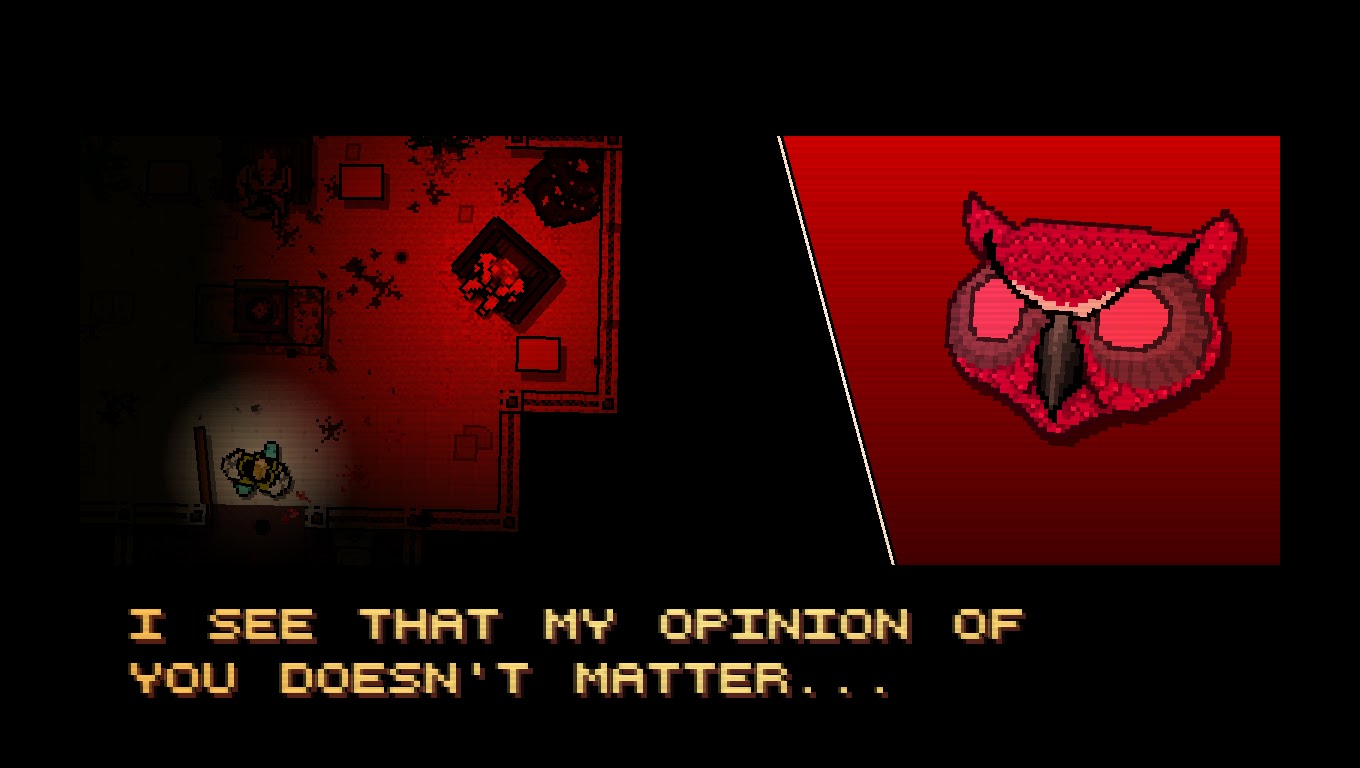
Hotline Miami Review - Trip On This
I'm not going to pretend that I can sum up what Hotline Miami is better than the game's publisher Devolver Digital, so here it is straight from the horse's mouth:
Gamers will step into the neon-soaked underground of 1980s Miami as bizarre messages on your answering machine seem to be urging you to commit terrible acts of violence against a nameless group of armed thugs. Overflowing with raw brutality and skull crushing close combat, Hotline Miami demands sharp reactions and a creative approach to navigate a gauntlet of 20 multiscreen missions. Wield 35 different weapons, collect 25 game-altering masks, and unveil a dark, surreal storyline that will force you to question your role in this murderous spree.
So there you have it: a nice basic summary of what this game is all about. Hotline Miami that takes a very barebones story and wraps it around a few simple gameplay mechanics that have some depth in execution, and then presents them all with a perfectly tuned aesthetic that marries each element together into a cohesive package. Three basic ingredients: Story, game, and presentation combined to make one game that is greater than each of those parts.
The Story in Hotline Miami takes place over the course of spring and summer of 1989. The majority of it follows the same pattern: phone message, killing spree, brief encounter with a "friend" at the video rental or pizza parlor. Most every day is like this. Occasionally your character will meet in a darkened room with three other masked individuals who'll menacingly question him about what he's doing. Somewhere around the midpoint of the game, it starts to get more and more clear that your character is becoming mentally unhinged or maybe has been all along. How much of the story is really happening is unclear after playing through it once, and towards the end you'll wind up seeing some things that seem to directly contradict portions of the game you'd previously played through. When it's done you'll probably have more questions than answers which really works in service of the story. I'm not sure if there's any real depth to the story, or if it is merely the illusion of depth, but they've managed to make it so that one is just as good as the other.
The game plays mostly as a tactical twin-stick shooter. Make no mistake though, charging in blindly guns a' blazing will just get you killed most of the time. You'll need to sneak around and dispatch enemies quietly with melee attacks for as much of each level as possible, since melee kills won't draw attention like guns do. Unless you're actively holding shift down and moving the cursor towards the edges of the screen, your field of view will be pretty limited. This gives the action kind of an up-close immediacy, forcing you to focus on one room at a time. Punches, opened doors, and thrown weapons can knock enemies down, taking them out of the action briefly and also making them vulnerable to gruesome execution attacks. Melee weapons are mostly one hit kills, and guns usually kill in one or two hits as well. You're as vulnerable as the enemy is, so you'll die a lot, but respawns are instant, allowing you to jump back in the action quickly.
For the most part, the game plays really great. It gives you a limited toolset and then allows you to use it in an almost sand-box fashion to plan your rampage across each level. It's very tactical and precise, but still occasionally devolves into a furious firefight or all out melee that'll have you improvising like mad in order to survive. It's challenging and unforgiving, but the penalty for failure is basically non-existent, so you won't get frustrated often. That's not to say the game is without any problems, though. The mask-powers are a cool idea but in practice you'll wind up sticking to one or two masks for the majority of the game. Boss fights are a frustrating low point that wind up requiring sheer luck and repetition in order to get through. Enemy AI is also somewhat unpredictable, with some enemies spotting and shooting you from off screen while others don't even flinch when you've busted down the door and emptied a sawed-off shotgun into their buddies on either side. These are minor gripes though, and added up are only a wrinkle in an otherwise compelling and addictive experience.
Finally, we get to the game's presentation, which in my opinion is the best thing about it. The music is astounding, and probably the best soundtrack in any game this generation. It fits the tone of the story, action, and visuals perfectly. Also, unlike most games set in the 80s, which play on nostalgia with their soundtracks, the music in Hotline Miami manages to fit the setting of the game while feeling incredibly modern and relevant at the same time. The visuals are another high point. There's a subtle way that entire levels seem to tilt as you move across them, and the colors are over-saturated, bright, flickering neon things that really enhance the dreamlike narrative. It would've been nice to see more enemy designs, but that's really the only bad thing I can say about a game that otherwise looks and sounds amazing.
So, with all that said, I can recommend Hotline Miami almost without hesitation. I say almost because there might be some people for whom the difficulty level, especially on the boss fights, might be too much of a barrier. Also, the game is really very short (I managed to finish it in about 3 hours), which might make the $10 price point sting a little. Unlockable masks, secrets, and going for high scores might add some replay, but without an online leaderboard to compete against I'm not sure how much the average player might get out of that. If you are at all interested, go ahead and buy it now on for the going rate. I think it's worth it, and this game is neck and neck with FTL for my game of the year, as well as being one of my favorite games released this generation.
Friday, September 14, 2012
FTL: Faster Than Light - Review
It's been a busy couple of weeks since Gen Con, with lots of work, comics and games keeping me up late at night, but none so much as FTL: Faster Than Light. Releasing tomorrow for PC, this is a game that had a kickstarter campaign a few months back to raise some additional funds for polish. The game was basically done at that point, but it seems the developers just wanted to add more content, art, and music. I didn't play any old builds of the game or anything, but the 200k they raised was obviously put to good use since they released a stellar PC game.
The Basics
FTL is a roguelike spaceship command simulator with a strong emphasis on exploration, ship customization and real-time combat. The goal of the game is to deliver a message to the federation fleet in the 8th sector, and defeat the rebel command ship there. To get there, you'll need to traverse 7 sectors filled with unexplored locations marked by beacons. What you'll find at each beacon varies, but mostly it can be broken down into a few categories including ships to fight, stores to buy from, or events that require you to make a choice such as whether or not you'll dock with a burning station to try and rescue survivors. As you progress you'll pick up scrap from battles and events that can be used to upgrade your ship's systems, as well as repair hull damage and buy new equipment, ammo, and crew at stores. The challenges you'll face increase in difficulty as you move on to new sectors, so you'll want to grind in each sector for as long as you can, but there's a set time limit since the rebel fleet moves through each sector and you're in for a difficult battle with no reward if they catch up to you, so it's best to make it to the exit location and jump to the next sector before that happens. I haven't yet beat the game, but it takes about 2-3 hours to get to the 8th sector on normal difficulty. Death is permanent, and while you can resume a game after a break there are no re-loadable saves.
I won't say much about the art and sound in this game, except to say that they're good. The graphics are clean and pleasant to look at, and the ship designs are varied and look cool. The sound effects are fine, and the music is outstanding most of the time and merely good the rest.
The Chewy Bits
The real meat of FTL is the ship combat. Each of your ships systems performs some critical task, such as raising shields, charging weapons, scanning enemy ships and allowing you to jump to a nearby beacon. Most of those systems work better when a crewman is manning them, so it's important to keep them at their stations. Crew also level up the more they do a certain task, so as the game goes on you'll get pretty attached to Jones the human pilot or Rebekah the Engi engineer. You can target specific systems on enemy ships, so depending on the ship you're facing it might be best to target their shields first and knock them down so you can then pound relentlessly on other systems. Timing is crucial, since your weapons have different cool-downs it is often best to wait until they're all ready to fire so you can launch a devastating volley. Alternatively, it might be best to go straight for their weapons or drone control with a missile so you can mitigate the damage they're doing to you. Ships even try to escape sometimes, so you'll have to make sure you keep their FTL drive knocked down so they can't charge it up and jump away. If the fight is going badly, you only need to survive long enough to charge your FTL and then assuming the pilot controls or engine aren't disabled you can jump away too.
While you're managing all this, the enemy is doing it right back at you so you've gotta keep a close eye on your systems and crew. Damaged systems, fire, and hull breaches can be repaired by crewmen so you've gotta order your crew around to take care of these things, but doing so often means they leave their station so for a while so you can expect to be operating at less than 100% efficiency. Sometimes that means you need to just go without life support briefly and watch the oxygen levels on your ship drop, or deal with shields that only charge up to half strength, or simply vent parts of your ship to space instead of sending someone to put out a fire. These are the decisions you'll have to make, and it can seem like a lot is going on at times but luckily the game allows you to pause at any time to issue commands, Baldur's Gate style, so the focus is placed firmly on decision making and not manual dexterity.
The combat is fun and challenging, and the variety of weapon configurations you can mount on your ship mean that you'll find yourself playing differently on each play. Rapid fire lasers, for example, are great at knocking shields down, but don't do much damage to systems or the hull. Missiles and bombs, on the other hand, breeze right through shields but consume ammunition. Drones use ammo too, but tend to provide more of an edge over time rather than doing a lot of damage up front. Then there's beam weapons, which do a ton of damage but have very little capacity to deal with shields. Finally, there are a lot of special weapons that do things like start fires, kill crew but cause no hull damage, or knock systems off-line for a short period of time. There's even additional systems and upgrades you can get like teleporters for boarding actions, cloaking devices and scrap recovery arms. Mixing and matching these weapons and systems, and seeing how they change the way you approach encounters is a lot of what makes FTL so much fun.
The Bottom Line
FTL is a blast to play. The sheer variety of what I've seen on each play has kept me coming back for more night after night all week. Last night, for example, I was fighting a boarding party with my crew of four when the AI decided to retreat its boarders and bomb the section of the ship where my crew were fighting, killing all but my 2 rock men who have 50% more health than other races. A routine fight with an automated sentry in an asteroid field can become an absolute mess when an unlucky missile knocks down your shields and suddenly every asteroid is damaging systems on your ship, causing fires and hull breaches. You might find that you've warped into a system experiencing solar flares and now you've got to manage a fight with an enemy ship as well as the fires breaking out all over yours damaging systems and hurting crew whenever the solar flares get too intense. There's really just too much to talk about here. I've put about 10 hours in so far and that's only with the starting ship. There are a bunch of unlockable ships and even alternate configurations for each one. The game even changes a bit depending on how you're upgrading your ship, with events having special options if you've upgraded along a certain path or have certain systems installed on your ship.
Buy this game. It's just $10, but would be a steal at almost any price. FTL takes the addictive "one more click" gameplay that used to belong solely to games like Civilization and crams it into the Star Trek game we've all been waiting for.
*Update*
So I have completed a single victorious play of FTL now, and wanted to make a few points about how to go about winning this game with the starting ship, the Kestrel.
1) If you can, get a cloaking device. Cloaking increases your evade by 60% which is a great way to dodge missiles, additionally it keeps your enemy from charging their weapons during the duration of the cloak but yours charge normally.
2) Don't neglect engine upgrades. Charging your FTL faster and increasing your evade rate (which paired with a cloaking device can get you over 100% evade while cloaked) can help turn a hopeless combat into one you get away from quickly.
3) Upgrade your shields to level 2 ASAP, it only costs about 70 scrap or so including a power upgrade and the 2nd shield will pay for itself in the early sectors. Later on get the 3rd level shield.
3) Get a second laser that shoots more than 1 shot. Volley firing your lasers can put 5 or 6 laser shots on target in one go, which is enough to work through even the most powerful shields. Burst laser II is already a super good weapon so a Hull Laser or another Burst Laser will give you a good starting point.
4) Conserve your missiles. The Pegasus missile will suit you fine all the way through the game. Don't waste missiles if you don't have to. Save them for knocking down shields or weapons on tough ships with lots of shields.
5) Pay attention when ships offer to surrender, gaining a crewman is worth 40-65 scrap. Gaining missiles and fuel can be worth more than a scrapped ship also. Try and do the math a little.
6) Blast doors are awesome, and make fighting fires and enemy boarding teams way easier.
7) Have a diverse crew. Having crew members of different races can open up a ton of dialog options for random encounters.
The Basics
| In the first sector: the rebel fleet hot on my heels. |
FTL is a roguelike spaceship command simulator with a strong emphasis on exploration, ship customization and real-time combat. The goal of the game is to deliver a message to the federation fleet in the 8th sector, and defeat the rebel command ship there. To get there, you'll need to traverse 7 sectors filled with unexplored locations marked by beacons. What you'll find at each beacon varies, but mostly it can be broken down into a few categories including ships to fight, stores to buy from, or events that require you to make a choice such as whether or not you'll dock with a burning station to try and rescue survivors. As you progress you'll pick up scrap from battles and events that can be used to upgrade your ship's systems, as well as repair hull damage and buy new equipment, ammo, and crew at stores. The challenges you'll face increase in difficulty as you move on to new sectors, so you'll want to grind in each sector for as long as you can, but there's a set time limit since the rebel fleet moves through each sector and you're in for a difficult battle with no reward if they catch up to you, so it's best to make it to the exit location and jump to the next sector before that happens. I haven't yet beat the game, but it takes about 2-3 hours to get to the 8th sector on normal difficulty. Death is permanent, and while you can resume a game after a break there are no re-loadable saves.
![]() |
| Perusing the goods at store Nothing for me here. |
The Chewy Bits
The real meat of FTL is the ship combat. Each of your ships systems performs some critical task, such as raising shields, charging weapons, scanning enemy ships and allowing you to jump to a nearby beacon. Most of those systems work better when a crewman is manning them, so it's important to keep them at their stations. Crew also level up the more they do a certain task, so as the game goes on you'll get pretty attached to Jones the human pilot or Rebekah the Engi engineer. You can target specific systems on enemy ships, so depending on the ship you're facing it might be best to target their shields first and knock them down so you can then pound relentlessly on other systems. Timing is crucial, since your weapons have different cool-downs it is often best to wait until they're all ready to fire so you can launch a devastating volley. Alternatively, it might be best to go straight for their weapons or drone control with a missile so you can mitigate the damage they're doing to you. Ships even try to escape sometimes, so you'll have to make sure you keep their FTL drive knocked down so they can't charge it up and jump away. If the fight is going badly, you only need to survive long enough to charge your FTL and then assuming the pilot controls or engine aren't disabled you can jump away too.
| The Rebels caught up to me but I got them after a close fight. |
| This nebula has cut my power by half, meaning i gotta turn some systems off to fight. |
The Bottom Line
FTL is a blast to play. The sheer variety of what I've seen on each play has kept me coming back for more night after night all week. Last night, for example, I was fighting a boarding party with my crew of four when the AI decided to retreat its boarders and bomb the section of the ship where my crew were fighting, killing all but my 2 rock men who have 50% more health than other races. A routine fight with an automated sentry in an asteroid field can become an absolute mess when an unlucky missile knocks down your shields and suddenly every asteroid is damaging systems on your ship, causing fires and hull breaches. You might find that you've warped into a system experiencing solar flares and now you've got to manage a fight with an enemy ship as well as the fires breaking out all over yours damaging systems and hurting crew whenever the solar flares get too intense. There's really just too much to talk about here. I've put about 10 hours in so far and that's only with the starting ship. There are a bunch of unlockable ships and even alternate configurations for each one. The game even changes a bit depending on how you're upgrading your ship, with events having special options if you've upgraded along a certain path or have certain systems installed on your ship.
![]() |
| I barely made it through this one. My Defense Drone II was a huge help! |
Buy this game. It's just $10, but would be a steal at almost any price. FTL takes the addictive "one more click" gameplay that used to belong solely to games like Civilization and crams it into the Star Trek game we've all been waiting for.
*Update*
So I have completed a single victorious play of FTL now, and wanted to make a few points about how to go about winning this game with the starting ship, the Kestrel.
1) If you can, get a cloaking device. Cloaking increases your evade by 60% which is a great way to dodge missiles, additionally it keeps your enemy from charging their weapons during the duration of the cloak but yours charge normally.
2) Don't neglect engine upgrades. Charging your FTL faster and increasing your evade rate (which paired with a cloaking device can get you over 100% evade while cloaked) can help turn a hopeless combat into one you get away from quickly.
3) Upgrade your shields to level 2 ASAP, it only costs about 70 scrap or so including a power upgrade and the 2nd shield will pay for itself in the early sectors. Later on get the 3rd level shield.
3) Get a second laser that shoots more than 1 shot. Volley firing your lasers can put 5 or 6 laser shots on target in one go, which is enough to work through even the most powerful shields. Burst laser II is already a super good weapon so a Hull Laser or another Burst Laser will give you a good starting point.
4) Conserve your missiles. The Pegasus missile will suit you fine all the way through the game. Don't waste missiles if you don't have to. Save them for knocking down shields or weapons on tough ships with lots of shields.
5) Pay attention when ships offer to surrender, gaining a crewman is worth 40-65 scrap. Gaining missiles and fuel can be worth more than a scrapped ship also. Try and do the math a little.
6) Blast doors are awesome, and make fighting fires and enemy boarding teams way easier.
7) Have a diverse crew. Having crew members of different races can open up a ton of dialog options for random encounters.
Wednesday, August 22, 2012
Android: Netrunner - Review
![]() |
| Some of the new Android:Netrunner Cards |
The Basics
So what sets this game apart from the scores of other two player card games in both the CCG and LCG format? Well, a lot of things, not the least of which is the fact that it's an asymmetrical game where both sides play completely differently. Without getting too bogged down in details, one player is always the corporation and one player is always the runner. The corporation's job is to advance and protect agendas that they install face down in servers behind layers of ice. Ice is also installed face down and kept secret from the runner who is trying to steal the agendas. It's only when the runner encounters the ice that the corporation must pay the rez cost of the ice to activate it. Ice has numerous negative effects on the runner, which are represented by its subroutines, but in general the purpose of ice is to end the run. The corporation can win if it advances its agendas and scores 7 before the runner can steal that many points.
![]() |
| An agenda worth 2 points. |
![]() |
| An icebreaker |
![]() |
| A tough piece of ice. |
That's the basic gist of the game, and it works totally fine. I'd like to change gears now and say a little about some other ideas that make Android:Netrunner stick out from the rest of the crowd. I'll use Magic: The Gathering as a reference point here because it's a game that I'm very familiar with, it's from the same designer, and it's probably the most well known non-traditional card game in existence. In MtG you can do any number of actions per turn so long as you pay for them with mana that is generated from land cards you play each turn. This is one of MtG's most defining attributes and also one of its greatest flaws, because drawing too few or too many lands means that you might just not be able to do anything, and with very few ways to draw more cards some percentage of games will find you either "mana-screwed" or "flooded" with too little or too much mana and no chance to win the game simply because of the luck of the draw. Android: Netrunner avoids this problem by giving you a limited number of actions per turn. The corporation receives 3 (but always draws a card at the start of their turn) and the runner receives 4, and with these actions they can draw a card, draw bits (resource), install cards (paying the bit cost, if the runner), advance agendas by paying a bit (if the corp) and more. The main thing to pay attention to here is that you can always draw more resources or more cards, so you're unlikely to get very far behind if you have a sub optimal draw.
There is a second difference that really makes this game stand out. That's the idea that you must interact with your opponent. In many other card games it's possible to build decks where your opponent's actions have no effect on how you play. A classic example of this might be the mono-red burn deck played in the Legacy format of MtG. Mono red burn actually doesn't care what its opponent does, its goal is to simply spit out as much damage as quickly as possible. By not playing any creatures, it invalidates a large portion of its opponent's decks and makes those cards "dead" cards. A deck like this does not seem possible in Android: Netrunner. For starters, there must be a certain number of agenda points in the corporation deck, so the runner will always have a chance to find them. The corporation can win by damaging the runner and forcing him to discard past zero cards in hand, but in most cases the runner must be actively doing runs in order to be targetted by the corporation's attacks. It's also difficult to find out what the corporation has installed in its servers without running them, so the runner must probe the corporations servers to find out if they contain agendas or if they are traps. Yes, the corporation has access to traps that look just like agendas until revealed, and it's awesome. All that said, interactivity is good and a thing that should be aspired to in games, and Android: Netrunner has a ton of it. Nothing is worse than sitting down to play a game and feeling like you've lost because of forces completely out of your control. That won't happen here.
![]() |
| One of the corporate factions. |
The Bottom Line
![]() |
| Operation with 3 loyalty pips (bottom left) |
Monday, August 20, 2012
Gen Con 2012 After Action Report
So I just got back from Gen Con 2012, and much like last year, I played a ton of games. I'll mention some of the ones I enjoyed there.
Games I played
Spartacus
If I recall correctly, the first game we sat down to demo was Spartacus. I have a fondness for ancient Rome and especially gladiators, but at the same time am kind of turned off by games based on television shows, so it was really going to come down to how the game played. The demo consisted of just one round, but what I can tell you is this: it seems kind of cool. The parts I like are the first phase where intrigues (event cards) are played and you can share the cost (influence) of playing those cards with other tables. You can make deals however you want to accomplish this, trading money, slaves, and gladiators for a hand in playing your card. However, you can also trade the PROMISE of those things, so a wise bargainer would ask for the goods up front. Even still, after the event is played there is no assurance that it will be played in the agreed upon way, which seems like it could result in a lot of shenanigans. After the intrigue phase there is a market phase where new gladiators, slaves, and items are bid on, followed by the opportunity to bid on hosting the next fight. The host of the fight gets to invite players to send their gladiators to their fight and that's where things seem like they might fall apart a bit.
I was kind of underwhelmed by the combat in Spartacus. As it stands the combats are only one on one. They take place on a hex grid but it seems like the maneuvering is somewhat unimportant, as once gladiators get locked in there is little point to maneuvering unless there's a difference in the speed of the gladiators, at which point the faster gladiator is at a huge advantage because attacks can take place before or after movement. The dice resolution for attacks, defense, damage and initiative are kind of cool, but I think the combat might get a little shallow after a while especially because of the aforementioned limit of single combat. There's some betting that takes place on the fight which is kind of fun and winning gets you influence which is the key to winning the overall game (there are other ways to get influence too). All in all it seemed kind of promising, but the one round we played was not enough to convince me of a purchase and I didn't get time to play a longer full game in the event hall.
Relic Knights
I got two demos of Relic Knights, one at the booth which was kind of railroaded but still fun and another more open demo with the designer talking me and another player through the game which was a bit more informative. Relic Knights is an anime-inspired miniature skirmish game that is characterized by fast action and match-3 inspired gameplay mechanics. Unlike most wargames, there little emphasis on judging ranges since ranged attacks have an infinite range and models tend to move very quickly across the battlefield.
Gameplay consists of alternating activations where you can move a model's first move distance, do an action, and then move the model's second move distance. The part where you do the action is where Relic Knights really shines, since there are no basic attacks in Relic Knights. Instead, every attack is done by playing a combination of power cards out of your hand to activate the ability. There's six colors of power, and it seems like most factions are focused on two primary colors with an extra third color thrown in to make things more challenging. Power cards have one major color worth two and one minor color worth one, and an example attack might have an activation cost of two red and one purple, so you could make that attack with any combination of cards in your hand so long as it added up to two red and one purple. Models are placed in an activation queue that specifies the order in which you'll activate them, so hand management becomes super important because you need to make sure you have the right colors in hand when the next model comes up. Luckily, the game mechanics allow you to cycle through your hand quickly enough that you won't get "mana-screwed."
There's a kickstarter going for this game right now that looks very promising in terms of value for your dollar. I've been a fan of the models since last year and playing with them at the con cemented my commitment to backing this game.
Alcatraz: The Scapegoat
Alcatraz is a semi cooperative boardgame from Z-Man games that was debuting at the con. Z-Man runs full demos of their games which is very cool, and it was cool enough for me to buy it. Expect a full review soon.
Android: Netrunner
Probably the talk of the con, Netrunner is the re-release of the cult classic TCG from the early 90's, dressed up all fancy in Fantasy Flight Game's LCG format. I played a ton of this over the weekend and will be doing a full review. Great game, even if the Android setting is kind of scraping the bottom of the cyberpunk barrel in my opinion. It's far more I, Robot staring Will Smith than it is Neuromancer.
Sky Traders
Sky Traders is a game of shipping goods and manipulating prices with an airship theme. Each turn involves buying goods and taking them around to different cities around the map which is made entirely out of hexes. There are six regular goods and two special goods, and at the end of each turn the six regular goods go up and down in price depending on dice that are assigned by the players. Each round you roll three dice and each of those dice has the power to change the value of a regular good by one step up or down. dice results can be traded for other dice and even for goods and money so this seems to be the main meat of the game: making sure you can sell your goods for more than you bought them for and turn a profit. This might be harder than it sounds because of limited cargo space forcing you to sell goods to make room for better ones and the chance to take damage which can eliminate one or more of your six holds and everything in them. At the end of the round players have a chance to buy influence, and the game ends once you've reached a certain influence level. Sky Traders seems like a fun game, but after two rounds I was worried that it might be kind of a one note song. It's not a bad song by any means, but I didn't sense a whole lot of strategic depth in the game.
Aerotech
Not a new game by any means, i played in an aerotech event designed to teach new players familiar with Battletech the rules of the game. All I have to say about aerotech is that it is a totally awesome game for crazy people, and actually far less complicated and ponderous than Battletech. The combats are far more lethal, determining line of sight is much simpler (cause, you know, you're in the air), and the game is an all around blast to play. I picked up a few Inner Sphere aerospace fighters and the 3039 technical readout so i could get the background stories for all the inner sphere designs that would later fight during the clan invasion. I don't normally like to play clan vs inner sphere, but we were told that the clan have less of an overwhelming advantage in aerotech than they do in battletech, so I'm looking forward to playing that game.
phew, that's enough for one day. I think I'll save my impressions of the show in general along with some of these reviews for some other time.
Games I played
Spartacus
If I recall correctly, the first game we sat down to demo was Spartacus. I have a fondness for ancient Rome and especially gladiators, but at the same time am kind of turned off by games based on television shows, so it was really going to come down to how the game played. The demo consisted of just one round, but what I can tell you is this: it seems kind of cool. The parts I like are the first phase where intrigues (event cards) are played and you can share the cost (influence) of playing those cards with other tables. You can make deals however you want to accomplish this, trading money, slaves, and gladiators for a hand in playing your card. However, you can also trade the PROMISE of those things, so a wise bargainer would ask for the goods up front. Even still, after the event is played there is no assurance that it will be played in the agreed upon way, which seems like it could result in a lot of shenanigans. After the intrigue phase there is a market phase where new gladiators, slaves, and items are bid on, followed by the opportunity to bid on hosting the next fight. The host of the fight gets to invite players to send their gladiators to their fight and that's where things seem like they might fall apart a bit.
I was kind of underwhelmed by the combat in Spartacus. As it stands the combats are only one on one. They take place on a hex grid but it seems like the maneuvering is somewhat unimportant, as once gladiators get locked in there is little point to maneuvering unless there's a difference in the speed of the gladiators, at which point the faster gladiator is at a huge advantage because attacks can take place before or after movement. The dice resolution for attacks, defense, damage and initiative are kind of cool, but I think the combat might get a little shallow after a while especially because of the aforementioned limit of single combat. There's some betting that takes place on the fight which is kind of fun and winning gets you influence which is the key to winning the overall game (there are other ways to get influence too). All in all it seemed kind of promising, but the one round we played was not enough to convince me of a purchase and I didn't get time to play a longer full game in the event hall.
Relic Knights
![]() |
| This might be my new favorite model from the line. It's bigger than it looks. |
Gameplay consists of alternating activations where you can move a model's first move distance, do an action, and then move the model's second move distance. The part where you do the action is where Relic Knights really shines, since there are no basic attacks in Relic Knights. Instead, every attack is done by playing a combination of power cards out of your hand to activate the ability. There's six colors of power, and it seems like most factions are focused on two primary colors with an extra third color thrown in to make things more challenging. Power cards have one major color worth two and one minor color worth one, and an example attack might have an activation cost of two red and one purple, so you could make that attack with any combination of cards in your hand so long as it added up to two red and one purple. Models are placed in an activation queue that specifies the order in which you'll activate them, so hand management becomes super important because you need to make sure you have the right colors in hand when the next model comes up. Luckily, the game mechanics allow you to cycle through your hand quickly enough that you won't get "mana-screwed."
There's a kickstarter going for this game right now that looks very promising in terms of value for your dollar. I've been a fan of the models since last year and playing with them at the con cemented my commitment to backing this game.
Alcatraz: The Scapegoat
Alcatraz is a semi cooperative boardgame from Z-Man games that was debuting at the con. Z-Man runs full demos of their games which is very cool, and it was cool enough for me to buy it. Expect a full review soon.
Android: Netrunner
Probably the talk of the con, Netrunner is the re-release of the cult classic TCG from the early 90's, dressed up all fancy in Fantasy Flight Game's LCG format. I played a ton of this over the weekend and will be doing a full review. Great game, even if the Android setting is kind of scraping the bottom of the cyberpunk barrel in my opinion. It's far more I, Robot staring Will Smith than it is Neuromancer.
Sky Traders
![]() |
| The six regular goods and two special goods in Sky Traders. |
Aerotech
| My Sai didn't get shot down! |
phew, that's enough for one day. I think I'll save my impressions of the show in general along with some of these reviews for some other time.
Tuesday, June 26, 2012
Diablo III Review - I'm Addicted to Hating This Game
I recently had a trip back to the west coast to visit my family. As is often the case when I'm traveling, I end up sleeping very little, staying up very late and waking very early, which leaves me with a lot extra hours with which to catch up on some PC gaming. Last winter it was Civ V that ate up my free time, this spring I decided to check out Diablo III.
I have a lot of experience with the Diablo franchise. I played a lot of the original game back when it had come out and for many years after until Diablo II was released. I completed it numerous times with all 3 classes and really just wrung it dry. Diablo II was an obsession for me. I played so much that I had NIGHTMARES about mis-allocating stat points. I quit playing one afternoon after I got the Buriza Do-Kyanon for my high level amazon. I remember feeling so elated and then so horribly depressed that finding a crossbow in a video game could stir up such emotions, and so i gave my account away to some random sucker on battle.net and that was that.
Since then, I picked the game up occasionally and played some other action RPGs (Titan Quest, also Torchlight) but they never really recaptured the magic of Diablo II. I had decided that I was pretty much done with the genre until an article I read on sirlin.net about the skill system in Diablo III piqued my interest, and so here I am again playing Diablo.
Diablo III
![]() |
| First rule of being a demon hunter: Always wear high heels. |
In case you didn't play the previous ones, Diablo III is an action RPG that pits your character against hell's minions in randomly generated dungeons. The story takes place over 4 acts, during which you'll kill tons of enemies, collect loot, and learn who is behind all the terrible things happening across the kingdom of Khanduras. It's all very grim, with native Khandurans having gone so far as to name their wilderness areas the "Stinging Sands" or the "Fields of Misery." Hell, there's even a farmer in the fields of misery and his farm is called the "Carrion Farm." What the hell sort of farmer names his farm that? Needless to say, the story is absolute rubbish; you're basically going to go from point to point collecting this or killing that until you find out who the big bad primeval behind it all is. In case you're dense, it's DIABLO. Spoiler!
![]() |
| Khanduras is a sucky place to live, but at least it's scenic. |
So the story is terrible, but how does it play- fantastically, actually. The combat feels extremely thick, with loud meaty sound effects, tons of destructible objects, and swarms of enemies to vanquish. It's incredibly satisfying to fell a horde of minions and then get a nice on-screen indicator that tells you exactly how many you killed in succession and what your xp bonus for that is. The entire genre is predicated upon our desire to be rewarded for clicking with magic items, and this game doesn't dissapoint. There are tons of bad guys, and tons of magic items, so click away to your heart's content and prepare to be loading your pack full of more axes, staves, daggers, and rings than you know what to do with. Add on to that multiple new game plus style difficulty levels and five distinct character classes, and you've got a grind-fest loot addict's action-rpg fantasy.
Blizzard also cut a lot of the extra non-combat clickery out of Diablo III. There are no more scrolls of identify or town portal; you can just do those things all the time now. Also, there are no more stat or talent points to assign (which is actually a good thing as discussed on sirlin.net and on the video below), and you're basically free to play with any combination of 6 talents active at a time. In addition, each talent can be modified by one of 5 runes that changes its effects, and you can assign up to three passive skills so there are quite a lot of builds to play around with for each character class.
So why do I hate this game? Well, a lot of reasons, most of which are related to the horrible effect that the auction house has on the game.
1) It sure is nice to pick up all that loot, but most of it is rendered completely fucking worthless by Blizzard's inclusion of an online auction house. My level 37 demon hunter never picks up anything that's as good as what I can get on the auction house, so everything i pick up either gets sent to the magic item chipper to be made into crafting materials or listed on the auction house for gold. For a game about loot, why is it that I'm more excited about picking up gold than I am magic items? That ain't right.
2) Crafting is absolute shit. So I can convert my useless magic items into materials for crafting, but then i still need to spend 1500 gold to make a crossbow with all random properties that'll most likely be shit. Gee, I'm sure glad I decided to spend 6000 gold crafting 4 random crap crossbows with +intelligence instead of just going and getting a good one on the auction house. Wasn't that fun?
3) There are a lot of talents and runes, but most of them are absolute crap. It's not REALLY a choice if you're picking between multi-shot which fires a spray of death out in a 60 degree arc that pierces through everything in its path, and a sentry turret that does 20% weapon damage to one target every once in a while when it decides to fire. Hmmmm, serpentine chakram with a tiny hit box that misses everything or a ball of fucking lightning that streaks out shocking tendrils at everything that even looks at it.... how do I even choose?
![]() |
| Welcome to the real game in Diablo III. |
4) Diablo III is not difficult. Previous diablos had sort of a rogue-like quality to them where you could just get stuck on some heinous shit. This could happen in late act I and early act II in Diablo II. I played through the entirety of Diablo III without any real challenge until the final boss. I'm most of the way through Act I on nightmare difficulty and am just now occasionally needing to drink a healing potion, and that's only when a rare monster has a particularly challenging set of special abilities. Everyone is probably thinking, "well of course silly, you're only on Nightmare!" I don't care! I shouldn't have to play through even 1 difficulty of practice mode before I get to the real game. Give me the real game right from the start, I'm 20 hours in at this point and have other shit to do. Please!
5) On that note, what the hell is even the point of health potions? Health potions are on a timer now, so you can only drink them every minute or so. You'll wind up with a billion goddamned potions in your pack that are worthless 'cause you can only drink them every once in a while. Why not just make it so that your potions got more potent as you went up in level, and you just have unlimited potions? Obviously the limiting factors for potions are potency and cool-down, not quantity. That's just bad design.
6) Damned if this game is not seriously repetitive. I mean, I know that's the genre, but really almost every combat encounter boils down to spamming multishot until everything is dead, and if anything lived I can just vault away and bola shot it, and even then if it survives i can hit a fan of knives and probably kill it at that point. That's it, every encounter is: right click 3-4 times, hit the 2 key, hold down left click, hit the 3 key. Occasionally I need to use some shadow talent to get health back. Sometimes I hit the 4 key to rain down a hail of arrows, JUST FOR FUN.
![]() |
| Fan of Knives! |
Whew, all that said, I'm probably going to keep playing this game off and on. It's not a good game, really it's bad, but I'm not above playing bad games. Despite being a one note song, the combat is still extremely satisfying for a reason I can't articulate. There's also some part of me that's hoping I'll eventually get to the REAL game. I suppose I could just not use the auction house, but really then I'm making up some new game to play with Diablo III. It would do me just as good to try playing with my feet or wearing a blind-fold. Hardcore mode sounds like a good solution, but with no offline mode available, the idea that I might get dozens of hours into a character only to die to a poor internet connection is dissuading me. Newcomers to the genre might enjoy it more than I do, but for me it seems like they took one step forward and two steps back with this one.
Friday, January 13, 2012
VVVVVVery Good Chiptunes - VVVVVV Review
Go ahead and hit play.
I picked up a copy of VVVVVV months ago. I think I got it as part of one of the humble bundles, probably the second or third one. It had sort of been languishing in my pile of unplayed PC games, which is by far the worst pile to languish in on account of how rarely I play PC games. That VVVVVV was sitting unplayed, it turns out, is very bad, because VVVVVV is a very good game.
![]() |
| Oh man he looks pissed. We'll invade Siam LATER, Oda. |
I was sitting in LAX awaiting my 12am flight to PHL so that I could hop over to ITH the next day and I had some time to kill. As is my custom, I had elected to arrive at the airport WAY too early rather than to have to worry for even one second that I miss my flight. It was during this time that I decided to bust the new laptop out to play some Civilization V which I had enjoyed a little bit too much over the break. However, it seemed that Oda Nobunaga's reign of terror was going to have to be put on hold because I couldn't get Steam to start in offline mode and thus couldn't play any Civ V. Without a good surface to mouse on my only other alternative was to fire up VVVVVV and I'm so glad that I did.
VVVVVV is a game all about simple charm. All you need to worry about is moving left and right, whether gravity is up or down, and spikes or other obstacles. Apart from that, it is a story about Captain Viridian's efforts to reunite his spaceship crew which have been scattered all over lost in some new dimension. It's a game not unlike Super Meat Boy, where you'll die hundreds (if not thousands of time) before you're through, but where death is of little consequence because the game is about discrete platforming challenges that are never more than a few seconds in length. Throw in a dash of collecting and a metroidvania style map and you know almost all you need to know about VVVVVV's gameplay.
The thing that really kept me going in VVVVVV, beyond the roughly 630 deaths in the 90 minutes it took me to finish the game, was the blistering chiptune soundtrack. These are tracks so compelling and perfectly matched to the gameplay that they transcend the nostalgia of the genre and sound completely contemporary. This is music that I would listen to apart from VVVVVV and not feel a hint of nerd shame about.
If you're at all interested in games, have $5 and a bit of patience, buy this game and enjoy the hell out of it.
Sunday, September 4, 2011
Limbo - Review. Also Mirror's Edge
So mostly I've been catching up on my pile of games and trying to get a steady schedule of painting progress on my Finnish Jakaari Kompania (note: mine look like shit compared to these). I've got most of the base colors done on the first combat platoon, and the second platoon has arrived in the mail and is patiently waiting for the weather to cool down so I can bear to sit at the table and trim some flash off of the models. I've found that the amount of time I can stand to sit and paint is approximately the length of one album, so I've been just throwing something on and having a listen most every night this past week while I get these dudes ready for some action this holiday season. In the meantime, I played two games. They were Limbo and Mirror's Edge. One of those games is A LOT better than the other one.
Mirror's Edge
Mirror's Edge effectively sums up everything that's wrong with the games industry and the game playing public. Basically, Dice made a game that is down-right transcendent at times, and somewhat frustrating the rest of the time. The end result was a unique first-person platformer that sold pretty poorly and was destined to be the only entry in the series until fairly recently. I have to admit I am guilty of not voting with my wallet this time around. I recall playing the demo and seeing the potential there, but for some reason I didn't wind up picking up a copy until just a few months ago at $20. I'm sure I'm not the only one. Anyway, maybe it says something about how pampered we are by easy modern games, but apparently people didn't like how you could expect to die every 15-30 seconds playing this game (which is humorous considering how well received the next game I'm going to talk about was). If you can get past the frustration of getting riddled with bullets at each enemy encounter and missing a fair number of jumps, what you're left with is a wonderful looking game that manages to be satisfying and fun in spite of all of its flaws. The story was some pretty brainless hippie bullshit, but luckily it doesn't get in the way that much.
Limbo
I took the opportunity to pick up limbo on the disc based XBLA triple pack that was on sale at Best Buy recently for $10, so I guess I paid about $3.33 for it. I sort of feel sorry for the suckers who paid $15 for this on XBLA when it came out (not sure what the price is now) and can understand the outrage at the same PSN pricing. Limbo is a perfect example of all style and no substance. What you get is a lot of "creepy", lethal black and white environments to platform and solve basic physics based puzzles on for about 3 hours. What you don't get is any coherent narrative whatsoever, or any reason to give a rat's ass about the little boy who is traversing these areas. The game was also intentionally designed on the premise that you should die unexpectedly and with nearly no chance to avoid failure at every puzzle, which seems like a cheap and lazy design choice. Rather than expecting that the player might succeed through skill or smarts, the game requires them to have additional knowledge that it is not presenting up front, and this leads to feeling like you're being cheated at every turn. I had a hard time understanding what people liked about this game. The gameplay itself was too simple to really be fun, and though I did get stuck on some of the puzzles for maybe 10 or 15 minutes, I don't think it was terribly challenging. The game got a lot of praise for its aesthetics which are fine, but really they came up with a decent looking style and did very little with it, making maybe 2 or 3 unique looking environments in the whole game. Luckily Trials HD was on the same disc, and that game is pretty RAD.
Tuesday, August 9, 2011
Post Game Report Gen Con Indy 2011 - Blood Bowl: Team Manager Review
I'm still sort of reeling from my trip to Indianapolis this past weekend. Between long days patrolling the show floor looking for cool games to demo, long nights gaming and little sleep between one day and the next, I still feel as though my brain is floating somewhere up above my skull, not quite all the way in. I played a lot of stuff on the floor and in the gaming hall, and had a really great time.
Since I'm pretty wasted still, here are the quick hits:
Relic Knights has some of the most beautiful models, and some pretty clever gameplay, but I didn't like them both together. My friend Peter said, "it's like puzzle quest." Yep, match-three gameplay and anime robot girls. The One Shot model makes me want to learn how to paint better.
THQ's Space Marine feels like a pretty derivative 3rd person shooter, though only being able to regenerate health by performing brutal melee attacks is a cool idea. The weapons felt nice, the action was decent, and THQ's love for the Warhammer 40K setting is well established at this point, so while this might not be a day 1 purchase for most, 40K fans will probably get a lot out of it.
Tanto Cuore was my obsession during the show, partly because of how ludicrous it was and partly because I secretly wanted it to be the best deck-building game I'd ever played. I liked it better than dominion, however the $50 price point seems way off base, even if the art and production values seemed pretty high. There are some solid ideas in that game, the best being the private maids and the ability to chamber maids by taking actions, pulling them out of your deck and scoring more points at the end of the game. Surprisingly, the demo consisted of an entire game. Misogyny..... sometimes it takes a game about being the "master" of a house of Japanese maids to make you realize what a pig you are.
Rune Age is a deck building game set in Runebound's world of Terrinoth. Ugh..... I didn't like this game. Not sure if it is because deck building games are pretty boring once you crack the formula to winning, or if because I generally dislike everything that has to do with Runebound. As much as I like FFG's Silver Line of games, I have to say STAY AWAY.
Blood Bowl Team Manager was the best game I played all show. Unfortunately it sold out on Thursday and I couldn't get a copy. A friend of mine did, however, and you can see my review in a bit.
Ascension..... that's another deckbuilding game. I like this one more than Dominion, but that's not saying much. It's easy to see the influence of Magic: The Gathering pro-tour players in the gameplay, but really they made a game that's like really linear Rochester drafting where you only sometimes get to pick the card you want. I accidentally made my friend buy the whole line. WOOPS!
Star Wars LCG. A cooperative LCG. I had a fun time demoing it, even though we only played it for one round. This is a game I would like to sit down and play any time, but not one that I would ever buy. I'm not a big fan of cooperative games (except for Space Hulk: Death Angel, of course), but I had a fine time playing this demo. It will probably sell pretty well.
Sedition Wars is Mike McVey's game. The models aren't bad looking. I hear the game is in beta still. The rules felt pretty rough to me. It didn't stand out.
Psi-Duel is a two player card-game about two psychics trying to melt each other's brains. I liked it enough to drop $15 on a copy. What it comes down to is a lightning fast (3-4 rounds) hand management game with some rock<paper<scissors elements.
The Ares Project is like a game me and Peter were working on, except finished and really good. Basically it is like a computer real-time strategy game. Think build orders, fog of war, base development, scouting, skirmishes, and attacks. We only played a very little bit during the demo but even that stuff seemed really cool, so I can only imagine what the rest of that game is like.
Dust is getting miniature rules that they were demoing on a very attractive table. The minis are rather nice, and the setting seems cool, but I was not super turned on by the miniature rules themselves.
Quarriors was another deck-building game, though this one used dice instead of cards and was designed in part by Eric Lang who worked on the Call of Cthulhu CCG. I liked Quarriors because it had a bit more player interaction (sort of), though I imagine that like most deck-building games it might get somewhat stale after multiple plays. In terms of depth, it ain't no Puerto Rico, but it was fun.
whew, i think that's all the stuff I played, except for the best game of all....
Blood Bowl: Team Manager
So, for those who don't know, Blood Bowl is the game of fantasy football. That is, fantasy as in there are elves and orcs and beastmen running around on the field. Based on Games Workshop's miniature/board game hybrid, Blood Bowl Team Manager is sort of the fantasy football game of fantasy football. Instead of controlling the actions of individual athletes on the field, players commit cards representing athletes to highlight cards (1 for each player) during each week of the season. Each week there are also special events that effect play and sometimes tournaments which function as sort of extra highlights that all teams can play on simultaneously. Each highlight can support two opposing teams, and the team with the most star power on one side of a highlight wins a reward printed in the center of the card, though both teams also receive a reward just for showing up. Rewards include fans (VPs), team-specific upgrades that give you static bonuses, star player cards and coaching staff upgrades that give you special abilities usable once per week. The goal of the game is to end the season with the most fans.
Each team (there are 6 in the game) has 12 athletes on it who play various positions including linemen, blitzers, throwers, blockers, and sometimes monsters like trolls and ogres. Each athlete has a Star Power attribute when standing, a Star Power attribute when tackled, and might have a number of icons that indicate which skills they have (tackle, cheat, sprint, or pass). They might also have a special ability written in text on their card. When an athlete is comitted to a highlight they resolve their icons in order, so they might cheat first and take a cheat token and then throw a tackle against an opposing athlete on the other side of the highlight, or they might pass which moves the ball (adding two star power to the team who possesses it) closer to their side of the highlight. The icons are all pretty useful, though I found that tackle and pass were a bit more useful than cheat and sprint.
Fans of the original will appreciate the tackle mechanics, which are resolved with special tackle dice that are very similar to those used in the miniature game except that star power doubles as strength in this game. Tackled athletes have lower star power, drop the ball if they're the ball carrier, have blanked text boxes and are removed from the pitch as casualties if tackled again. Including dice in the game introduces some variance and makes for some great upsets when your favorable tackle sometimes winds up knocking your own athlete down and reducing your team's starpower for the highlight. I thought the ball passing mechanic was nicely done, and makes for some great swings where your ball carrier can get tackled, returning the ball to midfield, and then the opposing player can play a thrower with the pass icon out of their hand to gain possession and the extra star power the ball gives. Even linemen, who are generally the worst players on each team come in handy with their ability to take a hit for another player, thus protecting your precious ball carriers. Cheating is a swingy mechanic that places a cheat token on the athlete that resolves when the highlight is being scored, and sometimes adds star power or fans, but can also get your athlete ejected from the game. Sprinting allows you to draw an athlete from your team deck and discard one from your hand, effectively letting you cycle linemen and other weak atheletes out of your hand in favor of strong blitzers, monsters and star players.
Each round players will usually draw and commit a total of 6 athletes split between two different highlights, though occasionally you might find yourself playing for more highlights. There is a lot of decision making here, as sometimes you will not be sure how committed your opponents are to winning a particular highlight until it is too late, and you might find out that you should have played more or better athletes to try and secure one highlight instead of spreading yourself too thin between two. After all players have committed their athletes, each highlight is scored and rewards are distributed, then a new week starts with new highlights. Play continues for 5 weeks and at the end of the season the team with the most fans wins.
Blood Bowl Team Manager is an absolute blast to play for newcomers and fans of the miniature game alike. The designers have managed to include a great assortment of teams which feel very different in play style and include Humans, Wood Elves, Dwarves, Orcs, Chaos and Skaven. The game is quick to learn but very challenging, and you will find yourself having to make tough decisions each turn. Play is quick, taking about an hour per game once you've got it all figured out. I expect that the great variety in teams, star players and upgrade cards along with the variance introduced by the tackle dice, special event and highlight decks will give this game great replay value. The production value was very nice, with excellent artwork and high build quality throughout, though I could have done without the tiny upgrade cards. I spent most of my free time at Gen Con playing this game and I highly recommend it to anyone who is even remotely curious about it. There isn't a lot that I didn't like, though I can see where some might not enjoy the variance in tackles and special events.
On a scale of 1-10, I'd give it a solid 8.5, which is relatively close to some of my favorite games including Shogun, Puerto Rico and Command's and Colors: Ancients, which I would score above a 9. At an MSRP of $35, this is a game you can't afford not to buy.
Sunday, July 17, 2011
Have You Seen The Yellow Sign? A Kirby's Dream Course Review.
I've been on a HP Lovecraft rampage lately. Finally picked up a copy of Call Of Cthulhu RPG, along with a book of published scenarios one of which I am hoping to run at Gencon Indy with some friends I'm meeting up with. This week I played the Catherine demo and it would be conservative to say that it left an impression on me. I am really, really, really looking forward to that game's arrival. In the meantime I'm working on a retrograde review article for Kirby's Dream Course (update 7/21/11, it's done). I think all the Cthulhu is getting to my head because it's hard too look at the spiky cloud guy and not think of Azathoth.
Monday, April 11, 2011
Back to Basics - Yomi Review
Despite the fact that Sony's PSP is an almost universally reviled piece of hardware in the Western press, there continue to be a steady stream, or more of a gently flowing creek, of amazing releases on the platform. These occasional blessings are likely in no small part due to its relative success in Japan, and soon another heavenly gift will have managed to float downstream to us here in the west in the form of the upcoming Final Fantasy IV Complete Collection. Originally released as Final Fantasy II on SNES, and then again with the correct Japanese enumeration on various platforms throughout the years, the game is arguably one of the best titles in a series now desperately in need of a break. In a refreshingly traditional move, this one will feature fresh sprites instead of the abominable 3D graphics that were found on the Nintendo DS releases of Final Fantasy III and IV. In an era where your average triple-A titles, which include the last few entries in the series, have production values that are through the roof it's nice to see Square Enix realizing that they can just go back to the essence of what made them a great company and turn that into something we all desperately need. Lets hope that when they cast their baleful gaze on Final Fantasy VI they will have the good sense to not disturb the bones of that game too much. A little bit of a touch-up is nice, but when you have a game that so perfectly defines the genre there's no need to go and mess with the basic ingredients. Which brings us to a new game that succeeds primarily because it presents the essence of a genre to a player in almost as pure a form possible.
Yomi - Boardgame (2011)
Yomi is a remarkable card game that expertly simulates the core tension that exists in a fighting game like Street Fighter. The game was designed by David Sirlin, who is a well respected competitive Street Fighter player and game designer who was responsible for the balancing on one of the best versions of Street Fighter ever released: Street Fighter II Turbo HD Remix. So, before even looking at the cards it's safe to assume that the guy knows a thing or two about fighting games. The game consists of 10 pre-constructed decks of cards(i.e. it's non-collectible) that represent individual fighters with their own special abilities, moves, strenghts and weaknesses. The decks are patterned after poker decks and feature the standard array of cards from ace to king in four suits. Two players will each pick a deck and proceed play the various attacks, throws, blocks and dodges printed on each card, hoping to beat their opponent's moves and do damage to them. It is basically rock-paper-scissors at its core, with attacks beating throws, throws beating block and dodge, and block and dodge beating attack. Dodges and blocks are unique in that successful blocks are returned to your hand and allow you to draw an extra card, and successful dodges allow you to strike back with a single attack. Players select their moves secretly and reveal them simultaneously and the game ends when one fighter is reduced to zero life, usually after about 10-15 minutes of play.
The core mechanics of Yomi are pretty simple, but once you get past the basic rules you'll see that much like the video games that inspired it there is quite a bit of depth to plumb for those who are so inclined. For starters, each card has two maneuvers printed on it so the direction that you play the card in matters and there are a lot of special moves with extra rules that go along with them like discarding extra cards, drawing cards or penalizing your opponent somehow. Trying to predict what move your opponent is going to throw based on how they tend to play and what moves they've played in the current match is the main thrust of the Yomi, but hand management also becomes a major consideration in a game where you're usually only drawing one additional card per turn. This is primarily because most attacks allow you to combo into additional attacks out of your hand, but your opponent can invalidate your combo after your first hit by playing a face down joker (the equivalent of the Burst move in the Guilty Gear fighting game series), so you might lay out an impressive and highly damaging combo only to have those cards go to waste. You also burn through your hand by discarding pairs, three of a kinds and four of a kinds to search your discard and library for aces which are usually a character's best attacks and can sometimes only be played in multiples. The mechanics of the Yomi breed a tension that comes from deciding when it's right to sacrifice cards and go all out to lay your meanest attack on your opponent or to hold back, keep your options open, and slowly build up your hand. Once you get the hang of it you'll learn to hold your big attacks until after you successfully dodge or your opponent is knocked down or in some other penalized state where you'll have an edge because their potential plays are limited. The intricacies of the combat system such as attack speed, knockdown and some of the deeper combo rules add a necessary granularity to an otherwise simple system, and the combination of fast play and tough choices each turn make Yomi a pretty engaging game overall.
So what's the deal with the 10 decks? For starters, the cards are well made and feel similar to a high quality deck of playing cards rather than your standard CCG cards. They're thin and flexible but not flimsy. The art is very high quality with a consistent and generally imaginative design, but it would have been nice to see more variety in the art for the normal attacks and throws. The differences between each deck are much more than cosmetic with each character having a unique set of moves and special abilities. Rook, for example, has no dodge moves, is throw oriented and though his normal attacks are slow they are very strong and he can sometimes just attack through an opponent's faster attacks. He's sort of the Zangief of the game. On the opposite side of the specturm, you have a character like Valerie, who is reminiscent of Chipp. Her individual strikes are weak but her attacks are fast she can combo any basic strikes together meaning she can pull off explosive combos regularly almost regardless of what cards are in hand. The other 8 characters are equally varied and include ninjas, diplomats, pandas and fish men among other things, and each one takes a bit of practice before you begin to understand what their best attacks are and how they match up against other characters. The game is available as matched pairs of 2 opposing characters ($25), or as a deluxe of all 10 that comes with play mats, counters and a box ($100). It's expensive, but the combination of portability and replay value mean that you'll more than get your money's worth out of it. Some tabletop or eurogaming purists might balk at the theme but it's hard to not recommend this game to anyone, especially if they have an appreciation for the material that inspired it.
Subscribe to:
Posts (Atom)